Introduction
Getting the compound right is only half the picture in specifying a rubber product. How that compound is cured matters just as much as what goes into it. Vulcanisation, also known as curing, is the process that turns uncured rubber into the tough, elastic material engineers design against, and it is often overlooked when the focus falls purely on material selection.
The term “vulcanisation” stems from Vulcan, the Roman God of Fire, although the process itself has mixed origins with Charles Goodyear and Thomas Hancock both developing and patenting the process on their respective sides of the Atlantic.
This blog covers what vulcanisation is, how it is carried out, and why it has such a direct impact on product performance in the field.
What is vulcanisation?
At a chemical level, vulcanisation builds cross-links between the polymer chains in raw rubber, using a combination of heat, pressure and a curing agent. Once those cross-links are in place, the chains can no longer slide freely past one another, which is what gives cured rubber its familiar mix of flexibility and strength rather than the soft, tacky feel of uncured stock. Sulphur is the traditional curing system and is still widely used, but peroxide, platinum and other systems come into play where a compound needs specific attributes to its application.
Why is it necessary?
Uncured rubber is not something you could build a product from. It creeps under load, tears easily, loses its shape and struggles at either end of the temperature range. Curing addresses all of that: it is what gives the finished part its tensile strength, tear and abrasion resistance, resilience, compression set performance, dimensional stability and long-term service life.
How does the process work?
The process starts with mixing: fillers, oils, pigments, processing aids and the curing package are all compounded into the raw rubber. That compound is then shaped, whether by moulding, calendaring or extrusion, and cured in a press, on a continuous curing line, or in an autoclave, depending on the product. Getting the cure right means controlling temperature, pressure and time closely. Under-cure and the part stays weak and deforms easily, over-cure and it loses flexibility and its fatigue life shortens. In practice, the cure cycle deserves just as much attention as the compound recipe itself.
Benefits for gaskets and extrusions
In a gasket, the curing ensures adequate recovery and less compression set, so the seal keeps its force over time instead of relaxing. In an extrusion, the curing ensures dimensional stability, better weathering performance, and the ability to flex repeatedly without cracking. Either way, how well a part has been cured has just as much bearing on field performance as the compound it is made from.
Vulcanised vs cold bonded joints
A vulcanised joint is chemically bonded during curing, so it becomes part of the rubber itself rather than sitting on top of it. That is what gives it fatigue resistance, as there is no adhesive to act as a weak point. Cold bonded joints, by contrast, use an adhesive to join two pieces of already-cured rubber. They are quicker and cheaper to produce, and work well for static or lower-duty applications. But once repeated flexing or high loads are involved, a vulcanised joint is usually the safer choice.
Common misconceptions
It is tempting to think of vulcanisation as simply heating the rubber up, but the chemistry, cure system and process control are what determine the properties of the finished item. There is a similar misconception around hardness: harder is not automatically better. The right Shore hardness depends on the sealing force, movement and wear the part will see, and the environment it is working in. It is worth looking at the full material specification rather than fixating on one number.
What about post-curing?
Post-curing is a secondary treatment, which J-Flex applies to many Silicone, FKM & Viton products. This is considered best practice as not only does it improve the mechanical properties by ensuring that the cross-linking is complete but it also eliminates volatile residues. This is critical in the food industry especially.
Frequently Asked Questions
What is vulcanised rubber?
Rubber that has been chemically cured to give it the mechanical properties needed for engineering use.
Can all rubbers be vulcanised?
Yes, correctly cured rubber has significantly better mechanical properties and durability than uncured stock.
Are vulcanised joints always necessary?
No, it depends on the application’s performance requirements, environment and budget.
Conclusion
Compound selection tends to get most attention when specifying rubber components, but curing also plays a big part in how the finished part performs. Whether you are specifying a gasket, an extrusion or a bespoke fabricated component, it is worth asking about the cure alongside the material.


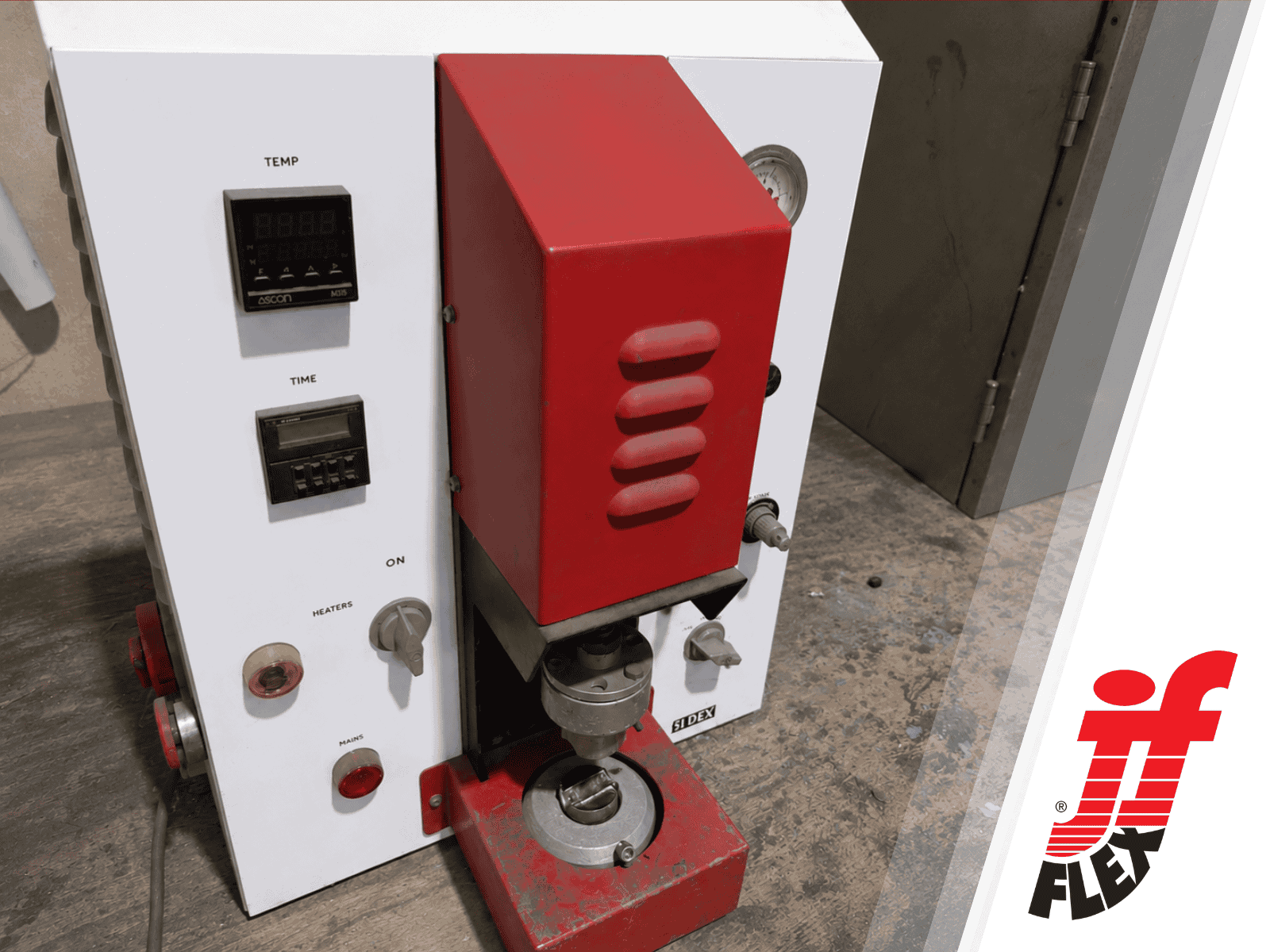
Pictured is one of the O-Ring Vulcanisation Presses in use at J-Flex!
About J-Flex
Over the last 42 years, J-Flex has positioned itself as the preferred supply partner for rubber-based products within technology-driven markets.
With expertise built since 1984, J-Flex provides high-quality engineered rubber components and specialist rubber sheeting you can rely on. From sheeting, mouldings, gaskets, sleeves, extrusions, bellows and fabrications, to sealants, we offer solutions across a wide range of polymers including Silicone, FKM/Viton™, EPDM, Neoprene, Nitrile and more.
Speak to the experts at J-Flex to find the right solution for your needs!